All posts by admin

Final-Logo-without-tagline-02

KHELO INDIA adopts the Law Of Natural Progression (Comment)

Im a sportsperson first. Anyone who pursues a hobby with some seriousness or plays a sport with certain dedication would understand, as I did at the age of 15-years, that sports is a potent instrument of ‘social engineering. It affects change and regulates the future development and behaviour of a society at large.

Sports is a level playing field where people employ their talent, skill, grit and determination to achieve a common goal outplaying their opponents, irrespective of their caste, creed or religion.

When Khelo India School Games became Khelo India Youth Games (KIYG), it was not merely a change of terminology but also in magnitude and scope. In the field of sports, that’s how the Law of Natural Progression works. As Mahatma Gandhi famously said, the Law of Progression applies to every righteous venture. A great sporting nation is where people play in large numbers in villages and cities that are like tributaries and add up to form a great reservoir of talent that never exhausts. An individual plays to realise his inherent talent and potential. Some are prodigious and go on to bring laurels to themselves and to those they represent – their club, district, state or nation.

The objective of government and non-government agencies alike is to provide encouragement, create enabling infrastructure at the doorstep, scout and hone talent, and let the sporting culture grow organically. Focus on sports at the school level leads to good players at the college level. The focus on Under-17s will create a cadre of prodigious players when they turn 21.

Thus, KYIG will push the Law of Natural Progression in sports by ensuring that every small effort counts and adds up to big results. There cannot be any piecemeal solution to realising India’s potential in the global sporting arenas.

Having made this broad point, let’s look at the larger picture. Under the leadership of Prime Minister Narendra Modi, as I see it, we have adopted a reverse engineering approach. The government is creating necessary linkages at the grassroots, a template for sports developments that’s easy to implement.

KIYG has standardised the sporting curriculum all over the country as more and more schools join in this righteous struggle. This initiative will lead to broadbasing of sports at the grassroots with both schools and pupils getting an incentive and opportunity to be part of this movement. A cultural shift in the way sports is played in villages and towns will determine how we fare at global events like the Olympics.

It’s a brave step by a visionary leader. The Prime Minister understands the importance of sports in asserting India’s rightful place in the comity of nations. He knows the ‘branding value of Sports’ in a world that’s fast shrinking due to the technological revolution, as more and more people are doing similar things across borders and cultures.

Sports, indirectly and directly, ensures better health, acts as a safety vault and a binding force in a diverse nation like India and inculcates the sporting spirit in people. A better performance at national and international levels ensures greater visibility for every stakeholder in a particular sport. Sports will soon be a lucrative career option. Therefore, winning medals in the Olympics has a much deeper significance.

Things don’t change in a day, especially when one is talking about changing cultural landscape of a country of a billion people. Therefore, the genius lies in the understanding of the ground realities and understanding the burden of the past to usher in a new tomorrow. There’s no denying that the identification and nurturing of talent is at the core of developing an overall sports ecosystem.

To sum up, KIYG will give the much required momentum and has already started showing results on the ground. Not only has it brightened India’s prospects at the Olympics, it also has been able to bring together all the stakeholders on one platform.

(Siddhartha Upadhyay is member of the Governing Body of the Sports Authority of India and Founder of STAIRS, an organisation dedicated to the uplift of sports. The views expressed are personal. He can be contacted at siddhartha@upadhyay.co)

www.business-standard.com

www.newsd.in

www.prokerala.com

www.ianslive.in

Ban tobacco, promote sports

Ban tobacco, promote sports (Comment: Special to IANS)

Let me start by saying that I don’t want to sound a fanatic, for I don’t suggest anything that I can’t do myself. I quit smoking recently. And that’s no small feat. Tobacco is the most common form of addiction and one of the most harmful as well, much more than the dreaded cannabis or for that matter Ecstasy, let alone alcohol.

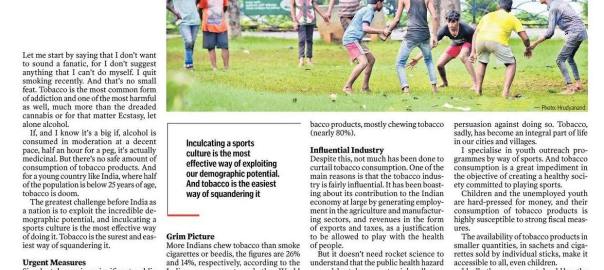
If, and I know it’s a big if, alcohol is consumed in moderation at a decent pace, half an hour for a peg, it’s actually medicinal. But there’s no safe amount of consumption of tobacco products. And for a young country like India, where half of the population is below 25 years of age, tobacco is doom. The greatest challenge before India as a nation is to exploit the incredible demographic potential, and inculcating a sports culture is the most effective way of doing it. Tobacco is the surest and easiest way of squandering it.

Simply, tobacco is a significant public health hazard, and something urgently needs to be done to discourage people from tobacco consumption. Just to give an idea of the enormity of the problem, globally, tobacco kills more people than tuberculosis, HIV/AIDS and malaria combined.

Remember, smoking a cigarette is just one of many ways of consuming tobacco. The consumption of smokeless tobacco in the form of snuff, chewing tobacco, tobacco leaf and gutkha is widespread amongst all age groups in India. There’s no escape, every second Indian is hooked on to one or the other form of tobacco consumption, and more often than not, it contributes to oral submucosal fibrosis, or OSF, is an established fact.

More Indians chew tobacco than smoke cigarettes or beedis, the figures are 26 per cent and 14 per cent, respectively, according to the Indian government and the World Health Organisation’s Global Adult Tobacco Survey of 2009-2010. Not surprisingly, nearly 80 per cent of oral cancer patients are tobacco users.

Recently the Indian Journal of Medical of Pediatrics published a study by Gauravi Mishra, Sharmila A. Pimple and Surendra S. Shastri that pointed to the fact that India is the second-largest consumer of tobacco globally, and accounts for approximately one-sixth of the world’s tobacco-related deaths. The Global Youth Tobacco Survey paints a grim picture of India. It was carried out amongst students of classes 8, 9 and 10, or roughly of the 13-16 age group. It was found that 15 per cent of students used tobacco products, mostly chewing tobacco (nearly 80 percent).

Despite this, not much has been done to curtail tobacco consumption. One of the main reasons is that the tobacco industry is fairly influential. It has been boasting about its contribution to the Indian economy at large by generating employment in the agriculture and manufacturing sectors, and revenues in the form of exports and taxes, as a justification to be allowed to play with the health of people. But it doesn’t need rocket science to understand that the public health hazard caused by tobacco outweighs all economic benefits many times over.

In the past, many states have tried to ban chewing tobacco but with little success. Take the case of gutka, a concoction of raw betel nut mixed with tobacco, which has been banned for some years now. To circumvent this, many tobacco companies started selling gutka discreetly, by selling pan masala paired with a separate sachet of tobacco. Though this may seem harmless, tobacco sold in small portions in a sachet actually facilitates its use primarily amongst teenagers. Many celebrities, from the film industry to sports, campaign for tobacco products, in spite of repeated persuasion against doing so. Tobacco, sadly, has become an integral part of life in cities and villages.

I specialise in youth outreach programmes by way of sports. And tobacco consumption is a great impediment in the objective of creating a healthy society committed to playing sports. Children and the unemployed youth are hard-pressed for money, and their consumption of tobacco products is highly susceptible to strong fiscal measures.

The availability of tobacco products in smaller quantities, in sachets and cigarettes sold by individual sticks, make it accessible to all, even children. Ideally, the government should ban the consumption of tobacco. But, till the time it’s done, at least the government should ensure two things. One, that 18 years and below are not to be sold any tobacco product. And two, the sale of tobacco products in small quantities, especially sachets which cost merely Rs 5 to 10, should be banned at the earliest. This will effectively curtail the access of tobacco products to sub-adults.

No half measures will suffice in the fight against tobacco. Ban tobacco.

(Siddhartha Upadhyay is member of the Governing Body of the Sports Authority of India and Founder of STAIRS, an organisation dedicated to the uplift of sports. The views expressed are personal. He can be contacted at siddhartha@upadhyay.co)

www.dailypioneer.com

www.business-standard.com

www.healthpost.in

www.dailypioneer.com

www.in.news.yahoo.com

www.msn.com

www.thenewsnow.co.in

www.ianslive.in

www.thesouthasiantimes.info

www.hiindia.com/

www.canindia.com

www.thepeoplepost.com

www.daijiworld.com

www.punjabupdate.com

www.andhravilas.net

www.windowtonews.com

www.vishvatimes.com

www.sportingindia.com

www.canada-today.com

www.telanganatoday.com

DSC_2933

Take a break to break world records (Comment: Special to IANS)

India’s performance in the world of sports is a matter of concern — with some notable exceptions. It requires no rocket science to realise the simple fact that we perform badly because we are poorly prepared.

This is not to indulge in a blame game, but merely to make it clear that recognising a problem is the first significant step towards solving it. And it is not quick-fix measures but a change in the outlook and attitude towards sports that is required — not just by the state, but by people at large. To do well, there is need for a social revolution concerning how games are played, how players are selected and how their talent is honed. They are, after all, our ambassadors.

Before getting into specifics, let us take in the larger picture. Every sixth person on this planet is an Indian but the country’s medals tally at any world class sporting event, particularly the Olympics, presents a dismal picture.

A lot has been said about the demographic dividend and clearly people are India’s most prominent asset; we have a huge and unlimited reservoir of talent. India’s dismal performance in the world of sport, barring a few like cricket, badminton, tennis (to some extent) and, of course, wrestling, is a reflection of the fact that we have failed to draw on this immense reservoir of talent.

There is no magic wand and those who claim they have one are lying. I do have a plan, though. It may sound disconcerting, but to me a good way to deal with the problem is to buy some time.

I am of the view that India should skip the next Olympics and prepare for the one after that, with the objective of not just participation but competing to win. Nothing succeeds like success — and nothing fails like failure. Both failure and success become a kind of habit. And to shun old habits, one needs to take a break to inculcate new habits. This break should be utilised to change attitudes towards sports and for talent-scouting at the grassroots. The shortlisting and honing of talent should start in the early teens. At the same time, world-class sporting infrastructure and training facilities should be created in various disciplines.

China is a good example and there is a lot of merit in the way it does things. There is, of course, much criticism about China’s “ruthless” way of producing champions that entail “human costs” to achieve sporting glory. I don’t entirely agree. To excel in sports, as in any other field, players need to get out of their comfort zones to prepare to compete with the best in the world.

There is no gain without pain. We need a futuristic plan and its execution has to be like a “rigid sports regime”. The leaders of China’s Communist Party rely on “command-and-control” systems that are inspired by the erstwhile Soviet Union. It is definitely demanding and rigid and may appear ruthless to some. But there has to be some merit in the way China prepares its athletes, or how else can it consistently be among the top three countries at the Olympics in recent times?

Their model is simple: Identify talent at an early stage and hone it in the next few years. China ropes in prodigies almost at a tender age on various parameters like agility, natural talent and body-type. They go through a rigorous training schedule for years in sports facilities/schools isolated from the comfort of their families. The family becomes secondary to the pursuance of their goal.

They are trained with a focused approach, depending on their physique and inherent skills at state-sponsored “boot camp-style” training centres. They live there as a big extended family with co-players, coaches and officials. Coaches are like parents in these more than 3,000 sports schools spread across the length and breadth of China that are responsible for nurturing the talent of some half a million children blessed with special sporting acumen.

The West, however, never fails to term the Chinese coaching method as systematic physical abuse to produce champions, with particularly the use of corporal methods being condemned. But then, Olympic historian David Wallechinsky famously told the Washington Post: “They can mobilise their population of 1.3 billion people by reaching throughout the country and doing the German thing of looking for children of certain body types and going to their parents and getting them to send them to national training centres”.

India will have to do something similar. To prepare for the 2008 Beijing Olympics, China short-listed some 30,000 athletes from the pool of talented youngsters from all over the country — more than ten times those who would actually get to compete. They were trained for years in 150 elite sporting camps. In this way, they were able to create a pool of world-class players. The best of the lot got to represent the country.

We need something of this nature to happen in India. Even at half the scale, the results will be there for everyone to see in less than 10 years. It requires political will and with Narendra Modi at the helm of affairs, there is no paucity of it. It is an advantage that India is a democracy — there can be a concerted effort involving all the stakeholders: Government, private sector and non-government bodies. It should be a partnership among all sections of society. This kind of a partnership is not unprecedented in India but is rare and is limited to a few sports like cricket, tennis or badminton, like the MRF-Pace Foundation or the Gopichand Badminton Academy, to name a few. They have done incredible work in their respective disciplines.

It is necessary to create the minimum sporting infrastructure at the base of the pyramid and build super-speciality training facilities that will work on sporting talent for five to eight years, with an increased focus on athletics and a few other selected sports. Of course, that will require a break — not just a break from the past, but a break from the present to break world records in the future.

(Siddhartha Upadhyay is member of the Governing Body of the Sports Authority of India and Founder of STAIRS, an organisation dedicated to the uplift of sports. The views expressed are personal. He can be contacted at siddhartha@upadhyay.co)
www.business-standard.com

DSC_4503

Sports is the best drug (Comment: Special to IANS)

Let there be no doubt. In life, there’s no bigger, and persistent, high than good health. No drug can match the thrill of competing in sports. Reality well lived is more enticing than the coloured vision of a drug addict.

There’s always hope, and life has this enviable capacity to bounce back, unless, of course, it is too late. All it takes is a moment of clarity to shun any form of addiction, howsoever incapacitating.

It may sound easier than it is. It is challenging to arrive at this profound moment of clarity, especially for those whose minds are crippled by addiction. This moment of clarity is the starting point for restoring life and fighting any debilitating addiction. It happens to those who have an abiding trust in the purpose of life and have the will to make it a worthwhile journey and not a wasted errand.

The real battle is fought continuously in the mind, during the addiction and de-addiction phases. Many of the de-addicted, or those in the process of de-addiction, suffer from what’s called “substance abuse disorder” or SAD and have shown the capacity to shun the past and look forward to life anew, if they get positive reinforcements.

Sports is one such positive reinforcement that can transform their lives by restoring healthy habits while doing away with drugs. There are certain critical behavioral aspects that make a person susceptible and, later, subservient to drugs. We call them dependencies, and they can be replaced with healthy habits just by indulging in sports.

In that sense, sports is not only a significant antidote to drugs; it is also preventive. Because, to play is a great way to deal with anger, frustration, stress and other such factors that drives people to substance abuse in the first place. Sports also provides the necessary distraction and vent to stress caused by denying the drug an addict is habituated to. It therefore supplements classical pharmacological and psychotherapeutic approaches to de-addiction.

Of course, there are players, some quite successful, who are found to be on drugs to enhance their performances, but that is a different matter. A performance-enhancing drug in sports is different from sports used as a potent tool to defeat drug addiction. Unlike psychopharmacologic and psychotherapeutic interventions, where the relapse rates are high, with sports as part of the intervention strategy, it is observed globally that the relapse rate is significantly reduced.

Sports is, as recent research has pointed out, an essential antidote to addiction and the best way to integrate the de-addicted into the mainstream. This is particularly true for young adults, as drug abuse makes them reclusive and incapacitates their ability to function in a social set-up involving more than two people. Research has found that sports, in young people, can lead to improved self-esteem, ability to handle stress, improved academic performance and better inter-personal relationships.

Moreover, providing players with structured opportunities to develop life skills, such as communication, decision-making and anger and stress management, can enhance the preventive value of sports as a tool for drug abuse.

Think about it: Sports is nothing but a social forum where people participate as equals and apply their minds and bodies to achieve a certain objective. Sports requires a rigorous application of body and coordination with others. The de-addicted need just that to be re-initiated in society.
Addiction is enticing and alluring, but drugs only kill. So, remember, there is no bigger high than good health.

(Siddhartha Upadhyay is member of the Governing Body of the Sports Authority of India and Founder of STAIRS, an organisation dedicated to the uplift of sports. The views expressed are personal. He can be contacted at siddhartha@upadhyay.co)
www.business-standard.com

DELIBRATE PRACTICE-6

The Qatar experience and lessons for India (Comment: Special to IANS)

The world is changing. Sport is a strong vehicle of change. And one of the best examples of this phenomenon is Qatar, which is on the fast track of modernisation and transformation ever since it clinched the right to host the 2022 FIFA World Cup. This is the first time that a mega sporting event of this proportion is being hosted in this part of the world.
 
Qatar has been at it for a long time. Finally, its protracted struggle bore fruit. Any sportsperson would vouch for this; nothing succeeds like success. Qatar has suddenly catapulted itself in the world of sports as a shining star. All the reservations like the regressive labour laws, poor human rights record, curbs on free speech and lack of integrated sports culture — all of these factors, individually and collectively — were sufficient to defeat Qatar’s claim to host the World Cup.
 
There’s also a raging controversy about how Qatar secured the bid. But Qatar won the bid in spite of all these hurdles. That Qatar won the bid, in my view, is simply historic.
 
The whole country is in a transformation mode, like a snake that sheds its old skin and emerges with a new one. I was in Qatar earlier this year and the change — and the pace of that change — is both bewildering and inspiring.
 
It’s estimated that more than $250 billion will be spent to prepare for the World Cup. New stadia and arenas are coming up, civic infrastructure is being upgraded manifold; hotels, railways, airports and freeways are fast transforming the country. One cannot escape the feeling that these changes are symbolic of the ambitions of a small country to make it big in the comity of nations.
 
Development and social justice via sports is the vision of Prime Minister Narendra Modi as well. India has much to learn from the Qatar experience. Just to give you an idea, there will be seven host cities — Al-Daayen, Al-Khor, Al-Rayyan, Al-Shamal, Al-Wakrah, Doha and Umm Slal — where 12 new state-of-art stadia will come up with capacities of at least 43,000 each. And the unique aspect is that part of these stadia could be dismantled after the event and transported to other less-developed countries to help set up the infrastructure for sports and encourage people at large to play.
 
Qatar, while creating a real estate marvel, will remain conscious of environmental consequences. Most of the sporting infrastructure being built is zero-carbon emitting and climate controlled.
 
Qatar’s success is not confined to just winning the bid to host the World Cup, but its commitment to modernising and upgrading its economy. An event of this magnitude is not just about creating the necessary sporting infrastructure in a stipulated time frame, but the emphasis is also on developing and internalising an enduring sporting culture in the two-and-a-half-million Qataris. To be able to do that, Qatar is already hosting almost 100 events every year in various sporting disciplines. The World Cup is not the end, but a means to an end.
 
Last month, Qatar Financial Centre (QFC) Chief Executive Yousuf Mohamed al-Jaida, speaking in London, elucidated the National Vision 2030 where the investment in sports would be an integral part of a multi-faceted strategy to ensure that economic development is diverse and sustainable. There have been wide-ranging labour reforms to make Qatar an enviable destination for foreign investment. There’s a move to end the Kafala system that falls foul of international labour laws by binding an employee to an employer in an almost “slave-like” manner. The Qatari government has also expressed its willingness to introduce a law on minimum wages.
 
Under the young and dynamic leadership of Hassan Al Thawadi, Secretary General of the Supreme Committee for Delivery & Legacy of Qatar, sports is the catalyst in the region’s social and economic development. In a recent address to the UN, Thawadi said: “Events of this stature (the World Cup) can bring billions of people together from every corner of the world. They can serve to accelerate and inspire…in a manner and at a pace that few other initiatives can match. Sport is uniquely equipped to play a significant role in attaining these goals. We are aiming for the stars, our feet are firmly on the ground.”
 
India should not just be committed to ensuring “ease of doing business” in the country, but also “ease of all segments of society to play”. Qatar’s experience has an encouraging message for India.
 
(Siddhartha Upadhyay is member of the Governing Body of the Sports Authority of India and Founder of STAIRS, an organisation dedicated to the uplift of sports. The views expressed at personal. He can be contacted at siddhartha@upadhyay.co)
49

German football model is a lesson for India

It’s an administrative triumph that India is hosting the FIFA Under-17 World Cup. It will be an inspiration for the youth and children to adopt and excel in the most popular sport of the world. This event is the first step in the right direction to realise India’s immense potential in the sport — but there’s a long way to go.

All the boys who are participating in the tournament are born in this century and are ambitious, motivated and have an attitude to excel. Indian boys are not an exception. The Indian team has done reasonably well, but not well enough as a host country is expected to do. I have come across some articles that describe the Indian team as a “sleeping giant”. There is nothing to be derived from praising mediocrity.

To appreciate a problem is the most fundamental step towards solving it. There are some pertinent questions: Why has India failed to realise its enormous potential despite having such a huge reservoir of talent? Why do we have to be satisfied with descriptions that seem more of a consolation, like a “sleeping giant”? It’s time the sleeping giant wakes up and performs on the football pitch and competes amongst the best. After all, producing champions is not rocket science — what is required is a planned, concerted effort.

There are two distinct areas where we need to work. Firstly, at the grassroots to find and hone the talent. Secondly, providing training and coaching to convert this talent into a cadre of world-class players. It’s not a daunting task or an impractical idea — the vision of Prime Minister Narendra Modi is to make India a sporting superpower.

Many countries have done it in their own ways. Let me talk about the German model. I was in Europe earlier this year and learned about how Germany improved their performance in just over a decade. They had to face an embarrassment in Euro-2000 and the administrators of the sport were determined not to let this happen again.

They started at the grassroots. Germany already had the necessary infrastructure; they upgraded it and increased the depth of coaching resources. Germany has 28,400 coaches with the B licence, 5,500 with A licence and 1,070 with the pro licence — the highest qualification.

While they honed skills, they also worked on the psychology of the players. Winning, as they say, is a habit, but a defeatist attitude could also become a habit. Winning is also a philosophy of life. The German coaches focused on developing the right attitude; what they call it is “fluid formations”, stressing on the need of nimbleness, dexterity and thinking players — instead of raw physical strength — who can work as a team. They weren’t interested in creating superstars, but a cohesive team They weren’t interested in creating superstars, but a cohesive team. Nimbleness and not the strength was the new mantra that did wonders.

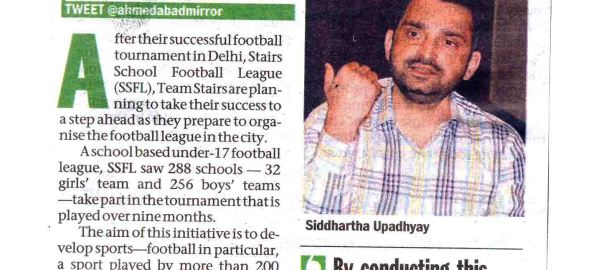
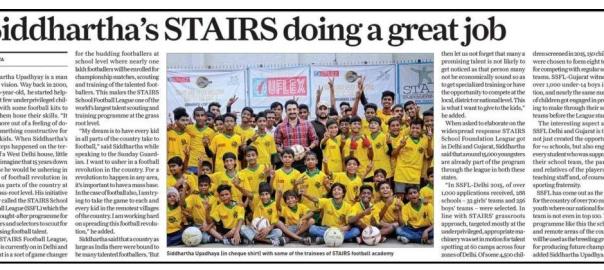
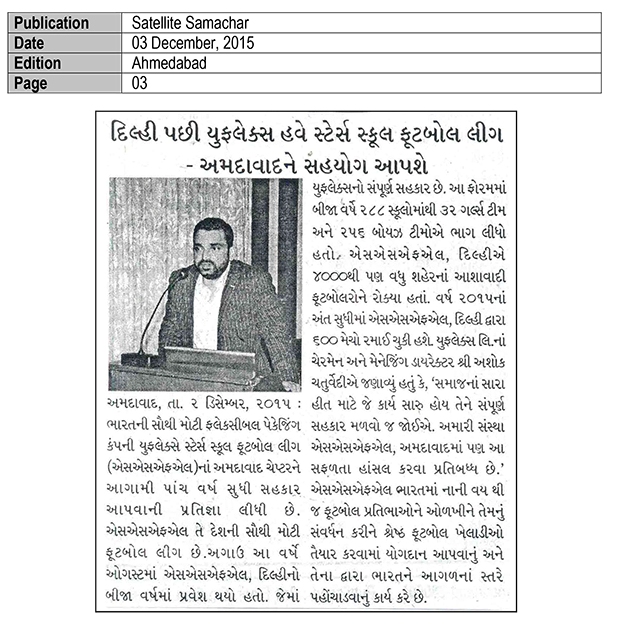
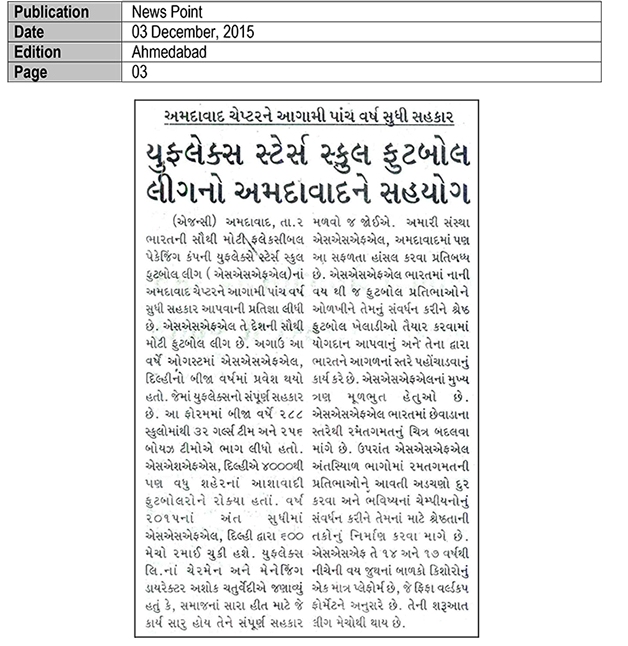
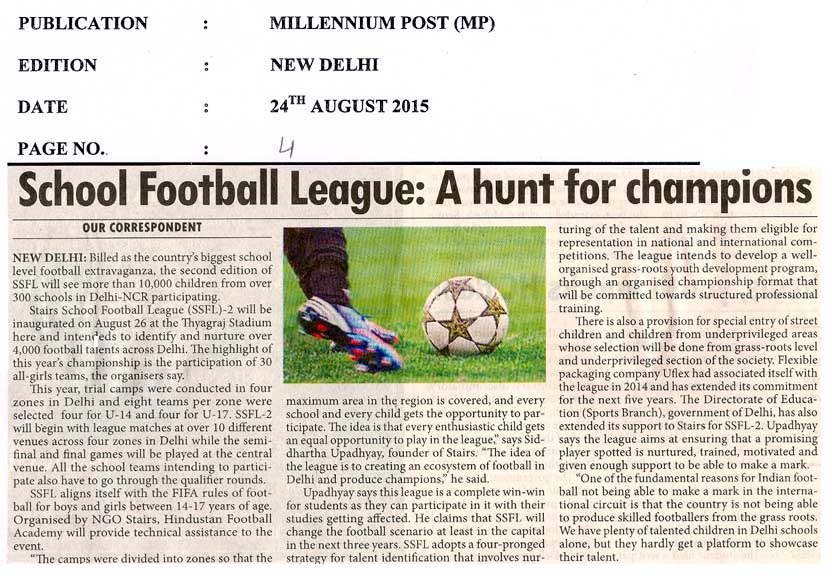
We organise various football camps in remote parts of the country and also a school football league (SSFL) every year where more than 60,000 children from Uttar Pradesh, Delhi and Gujarat compete in about 2,000 matches.
I see nimbleness is our strength and what is required is proper training to develop technical skills and tactical knowledge that can easily convert them into world-class players.

What we are doing in India is not very different from what Germany has been doing for the past decade to promote football in their country. Germany introduced a talent development programme in 2003 to identify promising youngsters, mostly aged 8 to 14 years. They are a country of just 80 million compared to India’s 1.25 billion. Just by renewed focus on the youngsters made them World champions within 10 years.

Not all the players will make it to the national side but there are professional clubs and junior teams — and there’s a lot of money to be made. So, there’s sufficient incentive. They have inculcated a sporting culture which has become a way of life.

In Europe there’s a long-held practice to get players on payment of a hefty amount of money from African, Brazil or Argentina. But Germany, thanks to the Freiburg facility, has realised it’s cheaper to train one’s own players. They now have plenty of them, which has created a healthy competition for excellence and the result is for everyone to see. Germany won the last World Cup in 2014, decimating Brazil 7-1.

The German experience has a lesson for India. We need a dedicated academy that will work on select few youngsters and churn out world class players on an annual basis. We need our own Freiburg kind of an academy.

Winning is a habit — and complacency a disease.

(A comprehensive article by Mr Siddhartha Upadhyay, member of the Governing Body of the Sports Authority of India and Founder of STAIRS, an organisation dedicated to the upliftment of sports. This article was originally published in IANS and featured in ET sites.)
www.economictimes.indiatimes.com

19dipa copy

India needs to promote woman power for better shot at Olympic medals (Comment: Special to IANS)

A few months ago, I was on a panel discussing how more women could be engaged in sports or how equal opportunities could be created for them in sports. Sitting on a platform set up by the country’s largest industry body that is backed by the government, it certainly did not make sense for anybody to criticise existing policies or programmes. Hence, I chose to present a case study — one of the most successful initiatives by the US government to increase women’s participation in sports — Title IX.

Before I write about the Title, let me make a prediction: the US will once again be taking home the highest medal haul in the 2020 Tokyo Olympics — almost 40 percent more than the second placed country (as it did in Rio in 2016 and before that in London) and most of those medals will be won by their women. I say that because unlike any other country in the world, women in the US have become a force for the Olympic team — making the gap for their male counterparts wider to match.

In Rio, US women won 61 of the 121 medals claimed by the US, against 55 by the men (five medals came in mixed events); and 27 of the country’s 46 golds. In London, women won 58 medals and the men 45.

However, this was not always the case. The credit for the rise of American women in sports goes to Title IX of the Education Amendments Act of 1972, a 45-year-old federal law that broadly prohibits gender discrimination in any educational programme that receives government funding. This rule means that schools must offer equal athletic opportunities to both sexes, a requirement that essentially funnels females into Olympic sports.

Colleges and high schools promoting soccer for boys have created different sports facilities and subsequently teams for their girl students in many streams. The trickle-down effect of Title IX is seen in areas where, at one point of time, it was almost unthinkable. It reflects in the number of youth leagues for the girls present in the country. I wonder if other nations — I could not Google even one — offer girls so many great sports options.

An American teenage girl from a family with below average income can afford to play waterpolo, do gymnastics, go for swimming and engage in basketball, football and soccer before deciding which sport she may continue with and excel at.

Take the example of Maggie Steffens, the captain of the US women’s waterpolo team. In India, we may not know much about this defending world champion and winner of of an Olympic gold in London (she was the youngest player in the team) and Rio. Steffens grew up in suburban California where she could play basketball, soccer and gymnastics and go swimming and also joined a club waterpolo team before she reached her teens. At 14, she was leading the waterpolo team; at 22, she was a world champion. Interestingly, this is not a standalone story from the US; each champion, each winner, be it Michal Phelps or another athlete, have had great opportunities, tremendous support and uncompromised infrastructure and facilities to excel in multiple sports.

Arguably, many other countries are investing in sports development. However, most of the programmes tend to benefit the “elite” athletes. There’s hardly a scheme or policy that gives budding sportspersons an environment to experiment with their talent or helps him or her in identifying the game of their interest, leave alone the mentorship that is needed at the beginning of your sporting career.

In total contrast to this, the US Olympic Committee keeps experimenting with new programmes each year. It spends millions of dollars only to create opportunities for young girls to engage in as many games as they can while the professional coaches and mentors are on the lookout for promising talent so as to guide them on a sport that they believe the girl may excel in. Yes, all before the girls are even in their teens.

In the US, the women’s wave has been building for decades. So, if we are seeing American flags leading almost every sports event across the world and witness their women leading from the front, it is primarily because the country is the reaping benefits of the great investments it made at its grassroots sports over four decades ago through Title IX.

Can a similar law in India make a difference is a question to which no one can give a definite answer. However, with the current establishment’s focus on empowerment of women, great investments are being made towards gender parity. Hence, something like an Indian version of Title IX makes much sense at this point.

Of course, Indian women have been making the country proud from the turn of the century when Karnam Malleshwari set the ball rolling. P.T. Usha, Ashwani Nachappa, the Phogat sisters, Mary Kom, Saina Nehwal, Sania Mirza and so many others are an inspiration. India reflected the US’s performance in terms of women winning more medals with P.V. Sindhu and Sakshi Malik winning medals in Rio 2016 and Dipa Karmarkar turning in an excellent performance.

It’s only now that more Indians are open to allowing women to play. The recent performance of the Indian women’s cricket team at the World Cup attracted a lot of attention and, according to reports, girls registering for cricket coaching has gone up since then. We need more films like “Dangal” and “Chak De India” to bring women’s sports into focus.

We need to enable women and support them in strengthening their resolve as they go into the next olympics. We need to get more girls come into the sporting system right from childhood and at the grassroots level.

Then let’s sit back and feel proud as the wonder women win the laurels.

A comprehensive article by Mr Siddhartha Upadhyay, member of the Governing Body of the Sports Authority of India and Founder of STAIRS, an organisation dedicated to the upliftment of sports. This article was originally published in IANS and featured in several news sites.

www.business-standard.com
www.sportingindia.com
www.theshillongtimes.com
www.thepeoplepost.com
www.india.com
www.financialexpress.com

5S5A6373 (1)

STAIRS Organizes Players Scouting Seminar in Gujarat

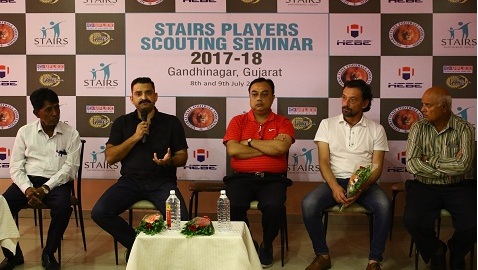
Ahead of Uflex STAIRS School Football League season-4, STAIRS organized one of its kind Players Scouting Seminar in Gandhinagar, Gujarat on July 8 and 9, 2017. The first ever 15 hour long seminar was conducted by Paulo Pedro , Technical Director, STAIRS Football Academy. Mr C. V. Som, Principal Secretary to Government (Housing & Nirmal Gujarat) was the chief guest. Also present on the occasion were Siddhartha Upadhyay, Founder & Secretary General of STAIRS, Mr. Gulab Chauhan, Secretary, Gujarat State Football Association (GSFA);Chairman of Referee Board: SSFL National Council and Mr. N Sisodiya, Secretary, District Football Association, Gandhinagar.

inchin-trade

Chinese calling on us with some lessons for our sports fraternity

the-india-versus-china-debate-asian-giants-common-interests-outweigh-differencesKnock, knock.
Who’s there?
Chinese!
Chinese who?
The sporting Chinese! The one’s you cannot ignore anymore.

While the country’s sports fraternity was busy analysing, condemning and commenting upon the doping issues, tragedies, scandals (I do not have the right word for it yet), I had just started reading about how several Olympic powers are doing. Instead of looking at internal ego clashes, lies and maligning politics, I was looking at the larger picture with a visionary’s glasses.

Interestingly, the sports developments at our neighbour’s made me pause and think for a while. While I have written about the grassroots development model of the Chinese here, I had not completely understood the business proposition of international sports that Chinese are heavily investing in – one area that our country must explore not only to remain relevant in the coming years in sports industry, but also to keep up the hopes of millions of sports lovers who play and watch games other than cricket, especially football.

What’s happening?

Since 2015, tremendous investments have been made by China in sports as the Chinese government has committed to success in international sports, particularly football. Chinese enterprises have followed suit with significant spending to acquire sports rights and establish global partnerships. China’s nascent sports market, which has been forecast by the government’s state council, is epected to grow to 5 trillion yuan by 2025.

You all must have read about China Media Capital’s five-year $1.3 billion agreement for exclusive global rights to broadcast the top-tier professional football Chinese Super League. This deal is way bigger than its Indian counterpart ISL. Other significant investments include Tencent’s $700 million digital partnership with the NBA. In India, basketball is one game that is yet to be explored. (Last time basketball actually made some news was when this one tall man from Punjab made it to some top NBA club only to be forgotten soon). Then there was this $1.2 billion acquisition of global sports agency Infront followed by Dalian Wanda’s $650 million purchase of the Ironman triathlon series. These deals mean business, development of sports and a great hope for the people in sports and whose livelihoods revolve around sports and of course fans and followers of games that were once foreign for China.

These developments in China, especially the kind of monies that have flown into the industry means there will be better spotting programmes, higher levels of coaching and training for developing better quality players and improvements in sports infrastructure.

These investments and partnerships are also creating multiple sports marketing platforms for brands. The ones targeting the children and the youth will have many opportunities to directly engage with their audiences.

inchin-tradeRevisiting Sports Sponsorship

Another notable development that I observed is that Chinese brands are using sports as a promotional tool for their global expansions. Huawei, Haier and ZTE entered into partnerships with mediums that were holding rights of popular sports outside of China in the past two years.

This strategy has been successfully implemented by Japanese and Korean brands including Sony, Canon, Samsung and Hyundai. Their logos have been quite prominent at the Olympics, FIFA World Cup, UEFA and other grand sporting events. Alibaba, the company that we all know as the pioneer of China’s e-commerce industry, is aiming to be the same in sports industry. In fact, it has subtly promised that it will bring the Football World Cup to the country.

Personally, I believe associating a youthful brand with large sporting events not only give brands the global audience; it also demonstrates the strength of the brand and establishes legitimacy at the same time. Chinese brands are playing their cards well here. In India, barring a few names like Hero, Tatas, Reliance, Uflex or PSUs like ONGC, no other business entity has adopted the strategy. Maybe the potential of sports marketing is yet to be explored by the big brands to become bigger.

“The potential of sports marketing is yet to be explored by the big brands to become bigger.”

Interestingly, ‘promotion’ of sports will most likely qualify as a corporate social responsibility (CSR) activity under Schedule VII of the Companies Act that mandates a certain section of companies to invest in CSR. Maybe this move will see some additional traction happening at the grassroots sports in India. We are keeping our fingers crossed.

Overall, this seems to be a beginning point of sports promotion as well as promotion through sports in China and by Chinese companies. This is happening at a time when sports need that additional impetus and that extra push.

I am not sure if Indian companies are yet to open their cards or they are yet to understand that nowadays when with available technologies that allow you to measure and analyze the impact of each penny spent in sports via simple data analytics systems. The innovative ways allow personalized fan engagement on a scale that one has never seen before.

Considering it is the fans base that have always been at the heart of a sports marketer, he does not have to depend in collecting information on the basis of approximate impressions generated via advertisements or expected eyeballs on hoardings in stadiums. Today, one can get insights into actual online and real-world behaviour of the audience. One can engage with them, get reactions from them and even, mobilize them to participate in an activity. The results – the RoI as they say in marketing terms – are visible, tangible and actionable. For example, being a lead sponsor of an event, if you just begin a feedback campaign via social media with a promise of some prizes, the fan base directly engages with you, communicates with you, talks about you.

“Starting this year, Chinese brands will be benefitting from this reinvention of sports marketing and sponsorship. What Indian brands should not miss out on is analysing the strategy. They may avoid going big all of a sudden, but can try associating with smaller, regional and more focused events with defined audience and fan base.”

ancient-chinese-sports-1Starting this year, Chinese brands will be benefitting from this reinvention of sports marketing and sponsorship. What Indian brands should not miss out on is analysing the strategy. They may avoid going big all of a sudden, but can try associating with smaller, regional and more focused events with defined audience and fan base. The marketers may try to analyse the integration of the sports marketing mix and experiment direct engagement with small target groups. For instance, sponsoring a small tournament engaging a few hundred children can give direct communication access to these children. You can speak to them on the field, interact with them on social media and continue with this communication by making them your permanent fan base.

Standing at this point, I see that the game has just begun, brands are busy assessing the conditions. They are yet to play their best strokes on a pitch where plenty of runs can be scored.